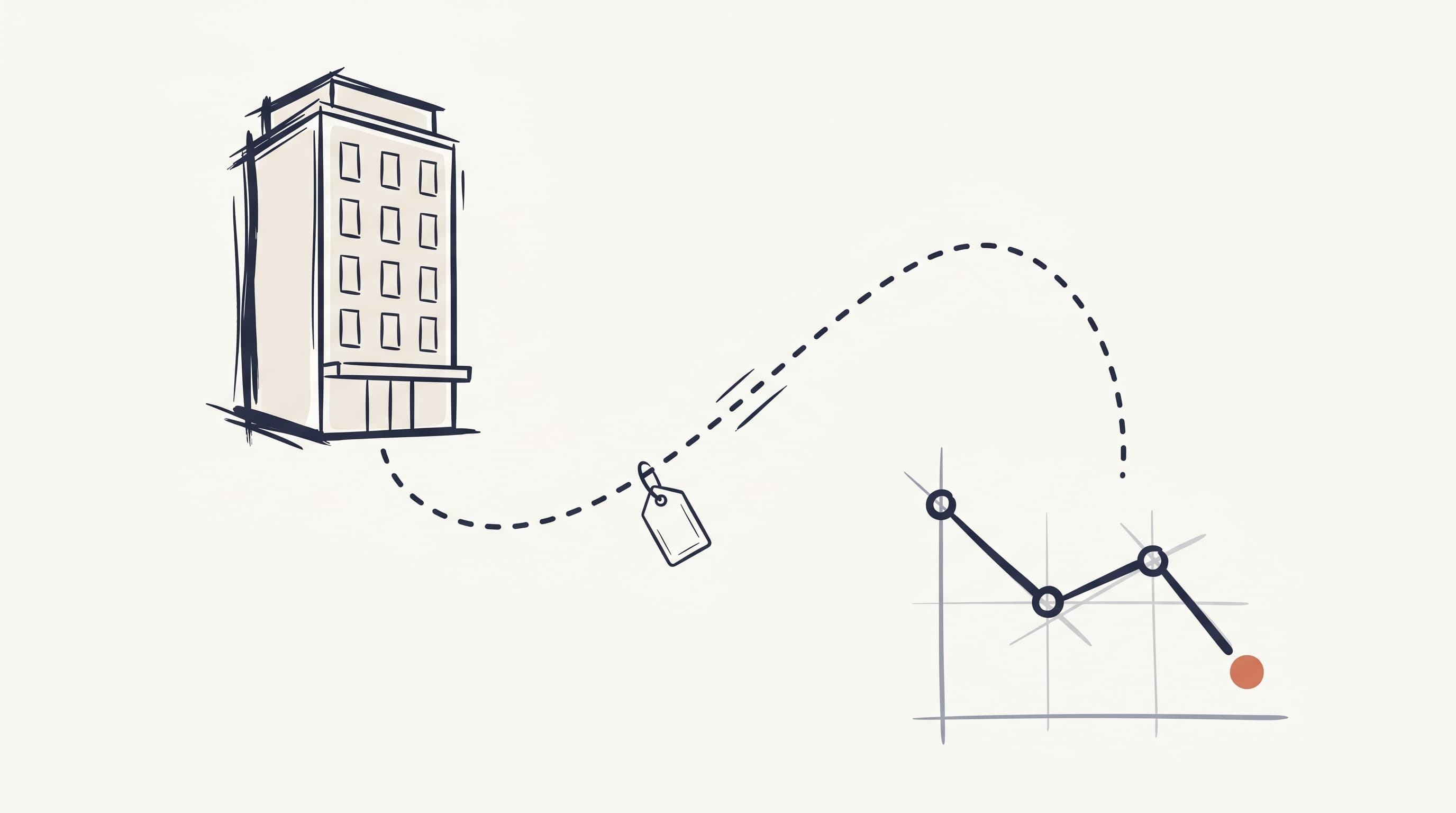
Short answer: yes. Frequently.
A RatePunk analysis of 28,000 tracked hotel bookings over 12 months found that 57 percent saw a lower rate appear between booking and check-in. Pruvo, another price tracking service, reports the number at 40 percent. Either way, the odds are roughly a coin flip that your hotel room will be available cheaper at some point before you arrive.
But almost nobody finds out. You book, you close the tab, you move on. Nobody sits there checking hotel prices every day for three weeks. So the price drops, you never notice, and the hotel quietly collects the higher rate.
Why hotel prices drop after you book
Hotels don't set a price and leave it. They use dynamic pricing algorithms that adjust rates thousands of times per day based on occupancy forecasts, competitor pricing, local events, booking pace, and how far out the check-in date is.
When a conference gets cancelled, occupancy projections shift. When a group booking falls through, a block of rooms suddenly needs filling. When a competitor drops their rate, the algorithm follows. None of these adjustments take into account what you already paid.
Rate volatility can hit 42 percent during peak seasons according to TravelScrape's 18-month hotel rate dataset. That means a room you booked at $250 could dip to $145 and spike back to $280 within the same week. The price you locked in was just a snapshot of a constantly moving target.
A $220 nightly rate tracked for 30 days between booking and check-in — the same room dipped to $145
We covered the mechanics in more detail in why hotel prices drop after you book.
How much do prices typically drop?
When a price drop happens, it's usually not pocket change. RatePunk's dataset puts the average saving at $62 per booking, with the largest single rebook saving $1,274 on a 12-night stay. Pruvo reports an average of $60 saved per rebook.
Say you book a three-night stay at $220 per night. Two weeks later, the same room on the same dates is listed at $175. That's $135 you're leaving on the table. Enough for a nice dinner, a day trip, or most of a flight upgrade.
The savings scale with the length of stay. A $45-per-night drop on a one-night booking barely registers. The same drop on a seven-night vacation is $315. HotelSlash, another tracking service, reports early users saved roughly 30 percent on average on rebooked stays.
When are price drops most likely?
Not every booking has the same odds of seeing a drop. A few patterns show up consistently.
Bookings made far in advance are more exposed. The further out your check-in date, the more time there is for rates to move. A booking made three months ahead will see dozens of price adjustments before you arrive. One made next week probably won't.
Shoulder seasons — the weeks just before and after peak — tend to see the most volatility. Hotels are adjusting aggressively as demand shifts, and rates can swing 20-30 percent in either direction.
Urban business hotels are particularly volatile. These properties live and die by occupancy, and a slow corporate travel week can trigger sharp rate cuts to fill rooms.
Big cancellation events matter too. When a conference gets cancelled or a group booking falls through, a block of rooms hits the open market all at once. Prices often drop sharply in the days after.
Non-refundable bookings and Airbnb-style accommodations are less likely to see usable drops. Even if the price changes, you can't act on it if you can't cancel.
Can you actually rebook at the lower price?
Yes, if you booked a refundable rate and your cancellation deadline hasn't passed.
Book the same room at the new, lower price. Confirm the new booking is locked in. Then cancel the original within the cancellation window. Always book first, cancel second. If you cancel first and the rate moves again, you're stuck with no room at all.
The hard part is timing. You need to spot the drop while the cancellation window is still open. A price drop that shows up the day after your deadline passes is just bad news you didn't need.
70 percent of travellers in 2024 considered flexible cancellation a requirement, meaning most bookings are made on refundable rates in the first place. Those travellers could act on a price drop if they caught it in time. They just don't know it happened.
We wrote a full step-by-step guide in what to do when your hotel price drops after booking.
How to know when your hotel price drops
Three ways to handle this.
Check manually. Set a calendar reminder a few days before your cancellation deadline. Search your hotel on the same booking site and on Google Hotels. If the rate is lower, rebook. This works for one or two bookings, but it doesn't scale past that, and you'll miss drops that appear between your checks.
Use price alerts. Services like Pruvo and HotelSlash monitor hotel prices after you book and send you an email when a lower rate appears. You forward your confirmation email, and they handle the daily checks.
Track prices and deadlines together. Most price monitoring tools don't know when your cancellation window closes. StayHawk does. It parses your confirmation email for both the rate and the deadline, monitors prices daily, and only alerts you when a cheaper rate appears while you can still cancel and rebook. A price alert after the window closed is just noise.
 StayHawk
Price dropped on your Hotel Le Germain booking
Montreal · Apr 18 – Apr 21 · 3 nights
You paid
CA$220/night
Refundable rate
CA$145/night
Your current booking is still cancellable until Apr 16.
What a StayHawk price drop alert looks like when a cheaper refundable rate appears
Hotel prices drop after booking roughly half the time, and the savings are real. The travellers who come out ahead are the ones who keep watching.
Frequently asked questions
Can hotel prices go down after you've already booked? Yes. Between 40% and 57% of hotel bookings see a lower rate appear before check-in. Hotels use dynamic pricing algorithms that adjust rates thousands of times per day, and your booking doesn't lock the market price — only your rate.
How often do hotel prices drop after booking? Between 40% and 57% of bookings see a price decrease before check-in, depending on the study. The further in advance you booked, the more likely you'll see a drop, since there's more time for rates to shift.
How much can you save by rebooking a hotel at a lower price? RatePunk and Pruvo both report averages around $60 per rebook, with individual cases ranging from a few dollars to over $1,000 on longer stays. The savings scale with the length of stay, since the per-night difference applies to every night.
Is it worth checking hotel prices after booking? If you booked a refundable rate, yes. The expected value is positive — roughly half of bookings see a drop, with average savings around $60 per rebook. Even a few minutes of checking can pay off significantly.
Do hotels care if you cancel and rebook at a lower price? Hotels expect cancellations on refundable bookings. That's why they offer both refundable and non-refundable rates — the non-refundable rate is discounted precisely because it protects the hotel from cancellation risk. Rebooking at a lower rate is using the system as designed.
Sources
- RatePunk — "In 57% of the cases you would have saved": 28,000-booking dataset, $62 average savings (RatePunk, Feb 2024)
- Pruvo — 40% of reservations see a price drop, $60 average savings (FinanceBuzz review of Pruvo)
- HotelSlash — Early users saved 30% on average (Thrifty Traveler, May 2023)
- Skift — Self-learning pricing engines update thousands of times per day (Skift, Oct 2025)
- TravelScrape — Hotel rate volatility reaches 42% during peak seasons (TravelScrape, 2025)
- Little Hotelier — 70% of travellers in 2024 considered flexible cancellation a requirement (Little Hotelier, 2024)
Forward your confirmation email to StayHawk and get alerted when the price drops — while you can still rebook. Start tracking for free — no credit card required.