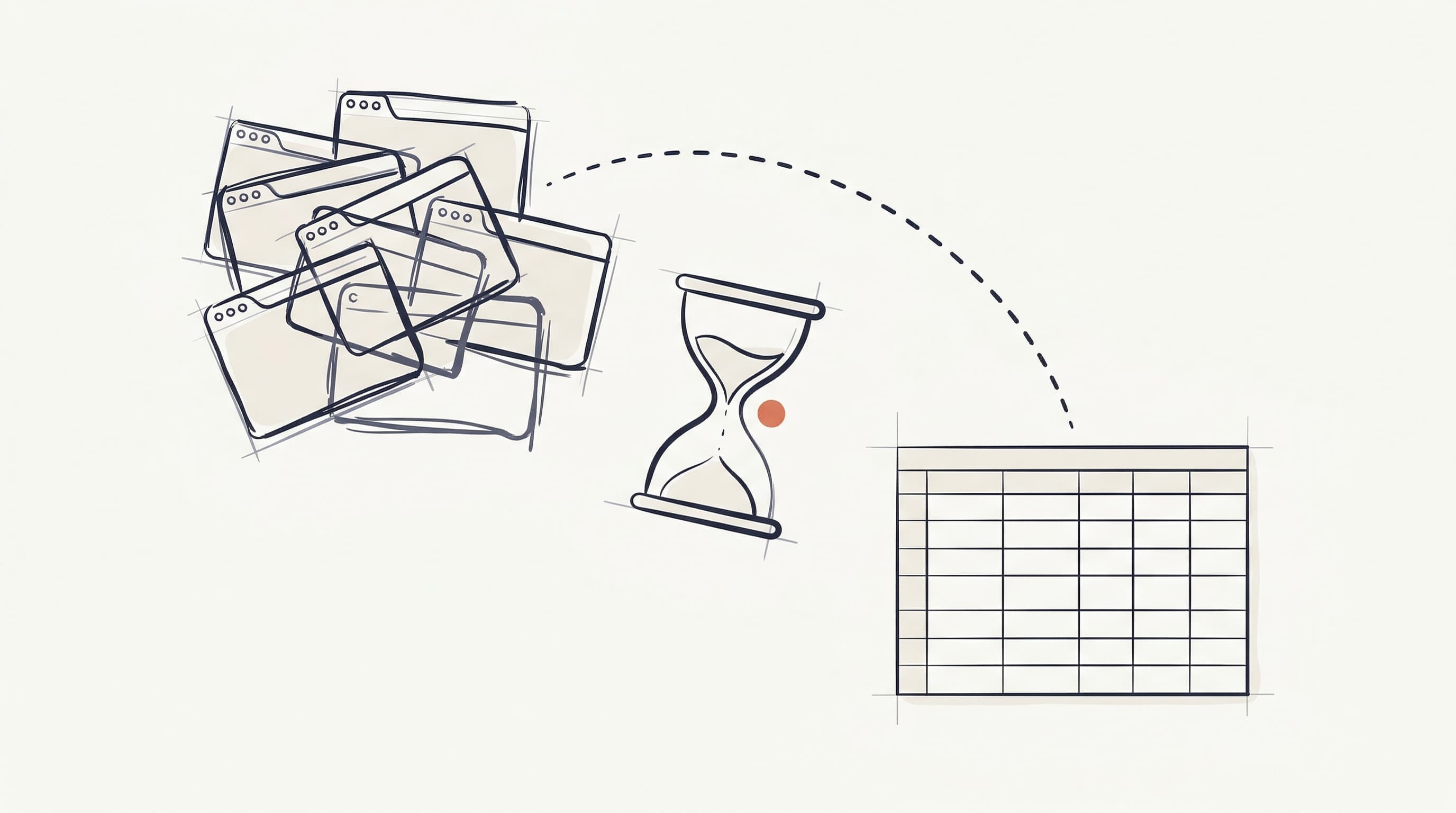
Hotel prices drop after you book more often than most people realize. Studies put the number between 40% and 57% of bookings. The average savings when someone catches a drop and rebooks runs $60 to $120 per stay.
That's real money. So why don't more people track their hotel prices after booking?
Because the tracking itself has a cost. Not in dollars, but in time and attention. And for most people, that cost is higher than they think.
The math on manual tracking
Say you booked a hotel for a trip three weeks out. You want to check whether the price drops before your cancellation deadline. Here's what that looks like if you do it yourself:
- Open a booking site. Search for your hotel, your exact dates, your room type.
- Compare the current rate to what you paid. Factor in whether the new rate is refundable.
- Check your cancellation deadline. Dig up the confirmation email, find the policy, figure out the actual date.
- Decide whether the savings justify rebooking. If the drop is $12, probably not. If it's $80, probably yes.
- Repeat this every few days until the deadline passes or you check in.
That's 10 to 15 minutes per check. If you check twice a week for three weeks, that's 60 to 90 minutes spent watching one hotel booking.
For a single trip, maybe that's fine. You're engaged in trip planning anyway.
Why manual hotel price tracking breaks down
Most frequent travellers have more than one booking at a time. Business travellers might have three or four upcoming stays. Someone planning a two-week trip with multiple hotels might have five or six.
At five active bookings, you're looking at 5 to 7 hours of price checking over the booking window. That's most of a Saturday, spent refreshing hotel search results.
And that assumes you actually remember to check. Miss a few days and you might skip right past a price drop that appeared Tuesday and disappeared Thursday. 85% of hotels now use pricing algorithms that adjust rates hundreds of times per day. Rates move fast enough that checking every other day still leaves gaps.
You're not just paying in time. You're paying in the drops you never see because you weren't looking on the right day.
What a missed hotel price drop actually costs
Take a common scenario. You booked a four-night stay at $200 per night. Three weeks later, the rate drops to $155 per night. That's $180 in potential savings.
If you were checking that day, you'd catch it. Cancel, rebook, pocket $180. But you weren't checking that day. The rate went back up two days later. You never knew.
Across a year of travel, the numbers add up. A frequent traveller with 10 to 15 hotel bookings per year, assuming 40% see a price drop and the average saving is $60 per rebook, is leaving $240 to $360 on the table annually. With larger drops ($120 average), that's $480 to $720.
Those numbers assume you catch every drop. Manual checking means you catch some. Automated tracking means you catch nearly all of them.
Hotel price tracking at agency scale
For independent travel agents, the math gets worse fast.
An agent managing 30 active client bookings needs to track 30 sets of prices and 30 cancellation deadlines simultaneously. At 15 minutes per booking per check, twice a week, that's 15 hours of price monitoring per week. That's not a side task. That's a part-time job.
There are roughly 190,000 independent travel advisors in the US. Most of them manage this with spreadsheets and calendar reminders. Their existing tools (Travefy, TravelJoy, TripSuite) handle itineraries and CRM but don't monitor prices or track cancellation deadlines.
Run the same math at agency scale: 30 bookings, 40% drop rate, $60 average savings. That's $720 per month in savings the agent could have caught for their clients. Miss those consistently and clients start wondering what they're paying you for.
When a hotel price tracking tool makes sense
The break-even math is simple. If the tool costs less than the savings it catches, it's worth it.
Pruvo is free and catches price drops, but only on partner OTA sites and without tracking cancellation deadlines. You'll know the price dropped. You won't necessarily know if you can still act on it.
HotelSlash is a paid annual subscription and monitors across 50+ sites. Same gap: no deadline tracking.
StayHawk combines both. Forward your confirmation email and it extracts the cancellation deadline, monitors prices daily, and alerts you when a cheaper rate is available while you can still cancel and rebook. The free tier covers 5 bookings with deadline tracking. Price monitoring starts on the Pro plan.
For a consumer with 10+ hotel bookings per year, one successful rebook covers the annual cost. For an agency, the portfolio-wide monitoring pays for itself within the first month.
Automated tracking vs. manual price checks
There's also the attention cost. Every 15 minutes spent refreshing hotel search results is 15 minutes not spent on something else. For agents, that's client work or sales calls. For everyone else, it's just life.
Manual price tracking works in theory. It falls apart in practice because it requires consistent attention over weeks, across multiple bookings, with no guarantee you'll be looking on the day the price actually drops.
Hotels are running pricing algorithms around the clock. Checking manually is a bet that your schedule happens to overlap with the dip. Sometimes it does. More often it doesn't.
Frequently asked questions
How long does it take to manually track hotel prices? About 10 to 15 minutes per booking per check. If you check twice a week across three weeks, that's 60 to 90 minutes per booking. With five active bookings, you're looking at 5 to 7 hours total.
Is it worth tracking hotel prices after booking? If you booked a refundable rate, yes. Between 40% and 57% of bookings see a price drop before check-in, with average savings of $60 to $120 per rebook. One catch pays for itself in time or subscription cost.
What's the cheapest way to monitor hotel prices after booking? Pruvo is free and monitors prices on partner OTA sites. HotelSlash is a paid annual subscription and covers 50+ sites. Neither tracks cancellation deadlines. StayHawk's free tier tracks deadlines on 5 bookings; price monitoring starts on the Pro plan.
How do travel agents track hotel prices for clients? Most don't, or they do it manually with spreadsheets. At 30+ active bookings, manual monitoring takes 15+ hours per week. Enterprise reshop tools exist but require GDS integration. StayHawk's agency plan covers 500 bookings with team workspace access.
Can I just set a calendar reminder to check hotel prices? You can, but you'll only catch drops on the days you check. Hotel pricing algorithms adjust rates hundreds of times per day, so a drop might appear and disappear between your checks. Automated tools check daily and alert you when a drop is found.
Track your hotel bookings and catch price drops before your cancellation deadline closes. Start tracking for free — no credit card required.